I love digging into old market disasters because the same human mistakes keep showing up over and over. There is one specific blunder that has wiped out fortunes in nearly every major crash on record. It is not greed or even bad luck the way most people assume from the outside. The mistake is buying with borrowed money and refusing to admit when the trade is wrong. Here is how that single habit has destroyed investors across centuries of market history.
The Tulip Buyers Who Bet the Family Farm
Dutch traders in the 1630s borrowed against their homes and businesses to buy tulip bulb contracts. When prices collapsed in February 1637, those debts did not disappear with the flowers. Many families lost everything because the loans were real even when the bulbs were suddenly worthless.
Isaac Newton Losing a Fortune in the South Sea Bubble
Newton sold his South Sea shares early in 1720 with a tidy profit and felt smart. He then watched the stock keep rising and bought back in much higher with borrowed money. He lost the modern equivalent of millions and reportedly said he could calculate planets but not human madness.
The Mississippi Company Disaster That Bankrupted France

John Law convinced thousands of French investors to borrow paper money to buy Mississippi Company shares. When confidence broke in 1720, the shares crashed and the paper money became worthless almost overnight. Whole French fortunes evaporated in weeks because the debt was real and the assets suddenly were not.
The 1792 Panic Caused by One Leveraged Speculator
William Duer borrowed heavily from banks and small investors to corner the early American bond market. His scheme failed and he could not cover the loans when prices moved against him. The collapse dragged down banks across New York and inspired the Buttonwood Agreement just months later.
The Railway Mania That Ruined Middle Class Britain
British investors in the 1840s borrowed against their homes to buy shares in new railway companies. Prices doubled and tripled before crashing hard in 1846 and 1847 as the bubble finally broke. Thousands of middle class families lost everything because the loans outlasted the imaginary railway profits.
The 1907 Panic Triggered by a Failed Copper Corner
Two speculators borrowed huge sums trying to corner the United Copper stock in October 1907. When the corner failed, their lenders collapsed and panic spread through the entire banking system. J P Morgan eventually stopped the bleeding, but countless smaller investors were already wiped out.
The 1929 Crash That Destroyed Margin Buyers

Investors in the late 1920s could buy stocks with only ten percent of their own money. When the market dropped in October 1929, those margin loans got called in immediately. Many people lost ten times what they originally invested because they owed the brokers the difference in cash.
The Dot Com Crash That Punished Day Traders

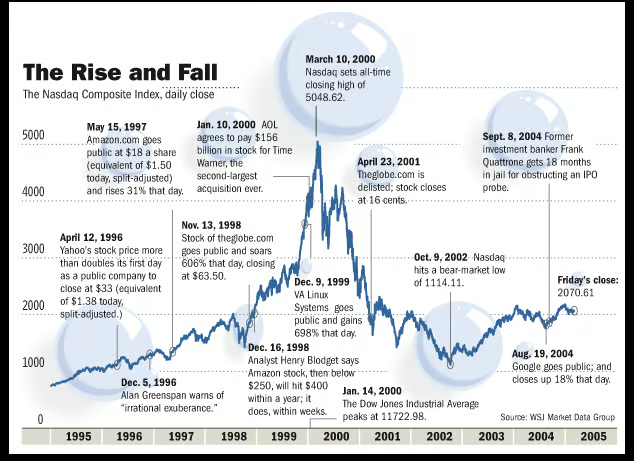
Many day traders in 1999 borrowed against their homes to buy speculative tech stocks on margin. When the Nasdaq dropped seventy eight percent between 2000 and 2002, those loans came due fast. Plenty of people lost houses, retirement accounts, and marriages over a single concentrated bet gone wrong.
The 2008 Housing Collapse Built Entirely on Leverage

Homeowners and banks alike piled on borrowed money during the housing boom of the early 2000s. When prices fell, the equity vanished but the mortgages and bank loans stayed exactly the same. Millions of households and several huge institutions went under because the debt simply did not budge.
The Lesson That Keeps Repeating Itself

Across four hundred years of markets, the same mistake keeps wiping out new generations of investors. Borrowing to chase a hot trade turns a bad call into a permanent disaster very quickly. Knowing this one piece of history is honestly worth more than any fancy investment strategy I have ever read.